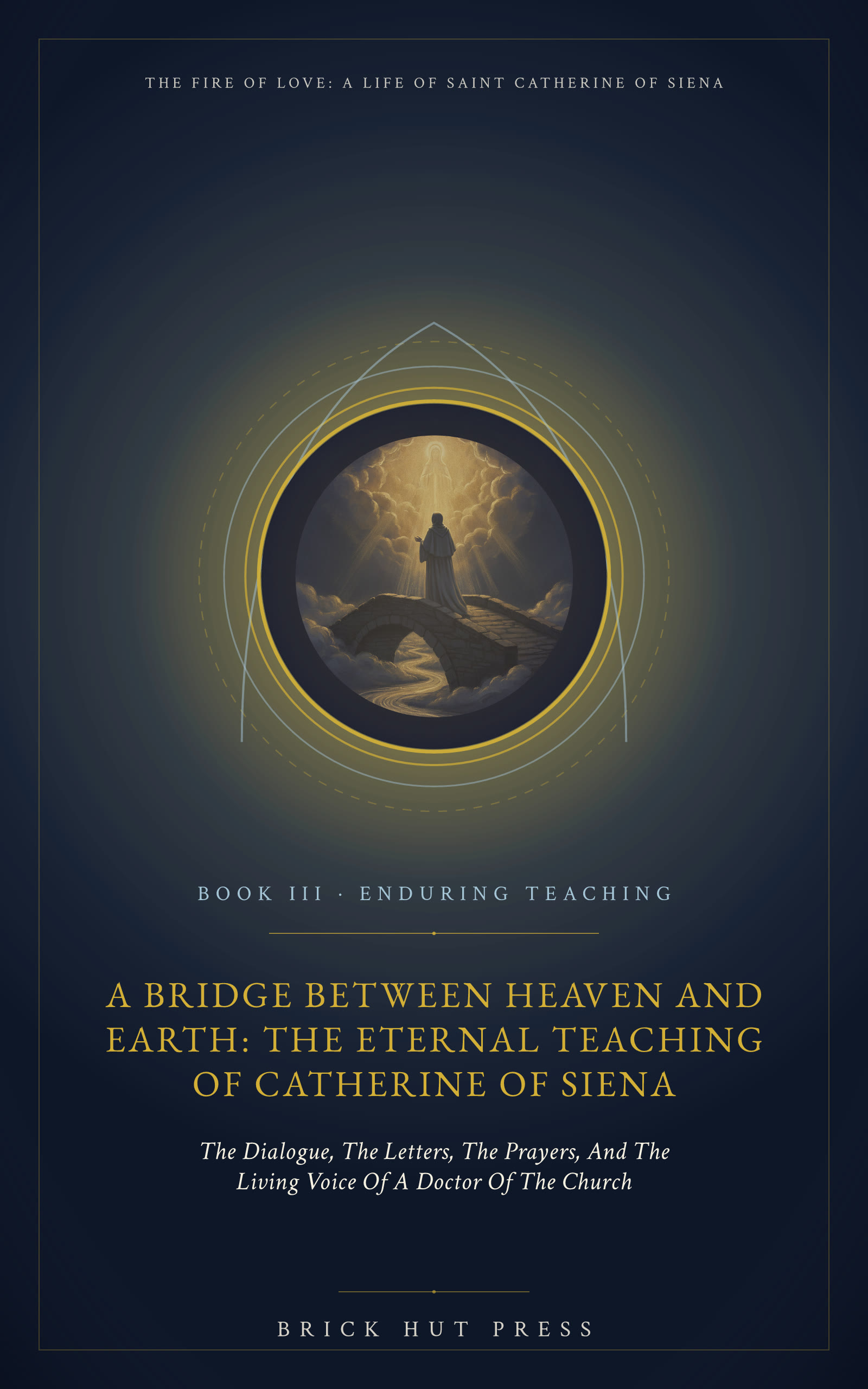
A Bridge Between Heaven and Earth: The Eternal Teaching of Catherine of Siena
Catherine of Siena was an illiterate dyer's daughter who became one of the most powerful voices in the history of the Church.
She Spoke to Popes. She Argued with God. She Is Not Finished Speaking to You. Catherine of Siena was an illiterate dyer's daughter who became one of the most powerful voices in the history of the Church. She dictated an entire mystical masterwork while in ecstasy. She wrote nearly four hundred letters, to popes, to prisoners, to generals and queens, and signed every one with the same fearless love. The Church named her a Doctor. History has never quite recovered.
Read the full description
And neither will you. A Bridge Between Heaven and Earth is a devotional companion unlike any other guide to Catherine's life and teaching. It opens her words, the Bridge, the divine mercy, the fire and blood of the Eucharist, the tenderness of a God who calls Himself mad with love, and places them directly in your hands. This is not a book about Catherine. It is a book with her, walking her teaching the way she intended it to be walked: as a living path from the soul's depths to God's own heart.
Not sure yet? Begin free.
The Fire in the Heart of Siena, a complete book about this life, free, kept in your own library here, read now; its narration joins free when it is finished.
Receive the free bookAbout this volume
This is the third volume in a trilogy on Saint Catherine of Siena, and it turns from the shape of her life to the substance of her mind, from the woman who walked the streets of the Fontebranda quarter to the teaching that outlasted her body by six and a half centuries. Readers who have followed her through childhood vision and public ministry will meet her here as the Church has always most needed to meet her: as a teacher, a Doctor, a voice still speaking into rooms she never entered. The volume opens where the teaching itself began, in the small room on the Via dei Tintori where three or four secretaries raced to keep pace with a dictation that did not pause for breath. That scene, strange and concrete at once, sets the terms for everything that follows: this is not a philosopher's treatise built at a writing desk, but speech poured out in ecstasy and caught, imperfectly, by trembling hands.
From there the book moves carefully through the architecture of her thought. The image that gives the Dialogue its shape, Christ as the bridge spanning the chasm between heaven and earth, receives its own chapter, as does her teaching on the interior cell, that place of recollection she insisted every soul could carry into the noise of ordinary life. A full chapter is given to her doctrine of mercy, the river she described as having no bottom, and another to her theology of the Eucharist, where she joined fire and blood into a single, startling image of what the sacrament costs and gives. These are not abstract summaries. Each chapter stays close to her own language, her own figures of speech, letting the reader hear how a Sienese laywoman without formal theological training arrived at teaching that would one day earn her a place beside Augustine and Aquinas.
The volume does not stop at the Dialogue. It turns next to the nearly four hundred letters that carried her pastoral ministry across Italy and into the papal court itself, correspondence that reached popes and princes, nuns and condottieri, with the same directness she brought to prayer. A chapter on her dealings with the papacy considers something the historical record makes plain and the devout have long treasured: that she addressed the Vicar of Christ with the same fearless intimacy she used in addressing Christ himself, neither flattering nor softening, because for her the two conversations were finally one conversation. Her twenty-six surviving prayers, dictated in raptures before her closest companions, receive their own careful treatment as a kind of liturgy of her heart, the place where her theology becomes, simply, address to God.
The closing chapters turn from the fourteenth century to our own. One examines what it actually meant, in 1970, for the Church to name her a Doctor, a title that carries real weight and real cost, since it asks the Church to say that a woman with no formal schooling taught truths the whole Body needed to hear. Another considers her patronage over Europe and why her voice has been reached for again in a continent uncertain of its own soul. The volume ends, fittingly, not with a conclusion but with a claim: that she is still dictating, that the voice the secretaries raced to capture on the Via dei Tintori has not gone silent, and that reading her now is less an act of historical curiosity than an act of listening.
Taken together, these eleven chapters offer not a biography retold but a portrait of a mind and a gift still at work. For readers who want to understand why the Church calls Catherine of Siena a teacher and not merely a saint, this is the volume that makes the case, patiently, from her own words outward.
Lives that walk beside Saint Catherine of Siena, chosen for their likeness, not their fame.