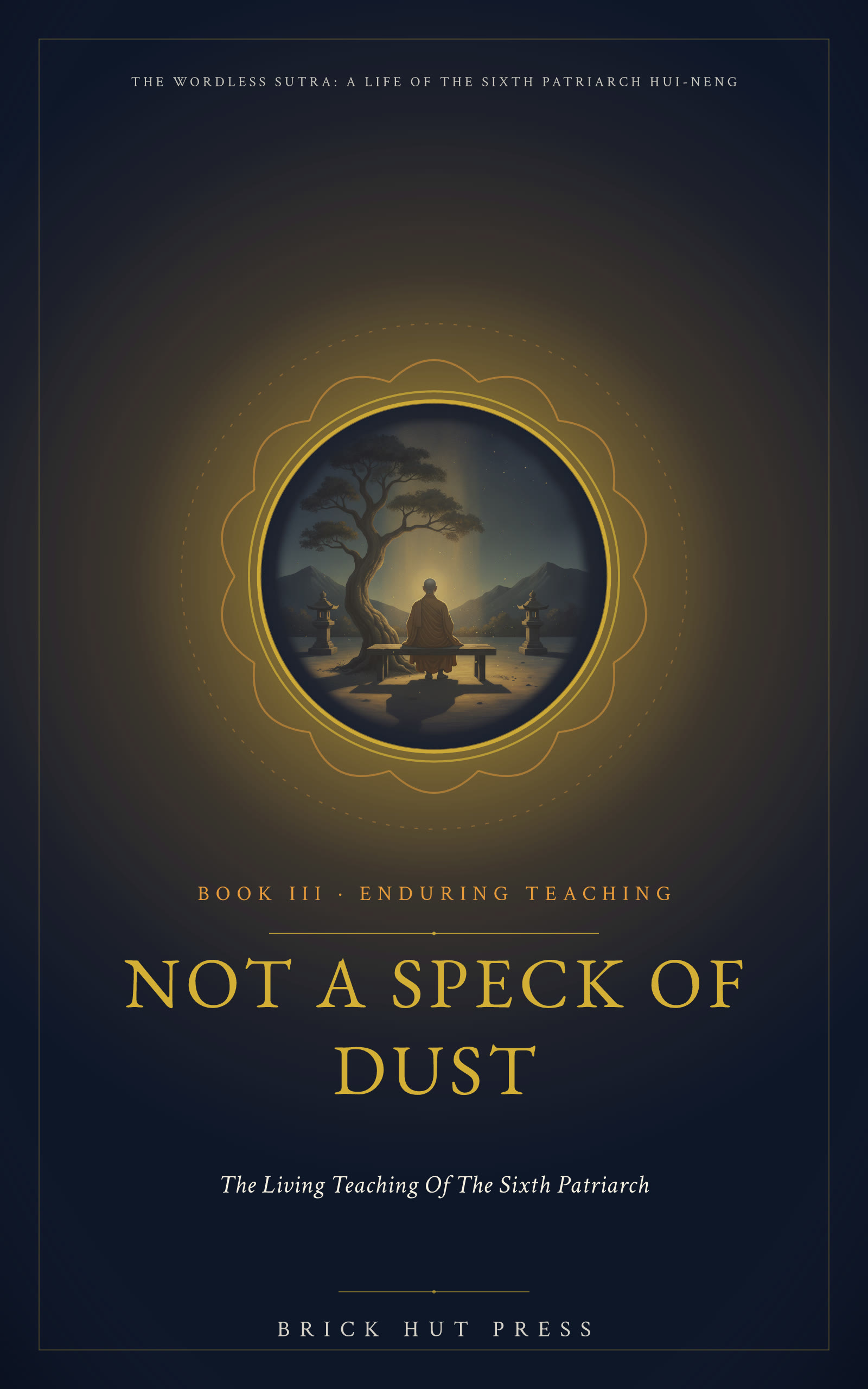
Not a Speck of Dust
Hui-neng was an illiterate woodcutter.
He Never Read a Single Word, and He Woke Up Anyway. Hui-neng was an illiterate woodcutter. He owned nothing, studied nothing, sought nothing. Then he overheard four lines from the Diamond Sutra in a marketplace, and in that instant, something shifted that has never stopped shifting. The Sixth Patriarch of Chan Buddhism didn't inherit awakening from a library. He recognized it, sudden and complete, as his own original nature.
Read the full description
Not a Speck of Dust asks the one question his life still presses against every sincere practitioner: what if you are no different? Written from deep within the living Chan tradition, warm, unhurried, and unapologetically direct, this is not a scholarly biography or a distant historical portrait. It is a transmission. Drawing on the Platform Sutra's radical simplicity and fifteen centuries of practice lineage, Not a Speck of Dust holds up the mirror Hui-neng always intended. The face looking back is your original face. It has never been touched by a single speck of dust.
Not sure yet? Begin free.
Pointing at the Autumn Sky, a complete book about this life, free, kept in your own library here, read now; its narration joins free when it is finished.
Receive the free bookAbout this volume
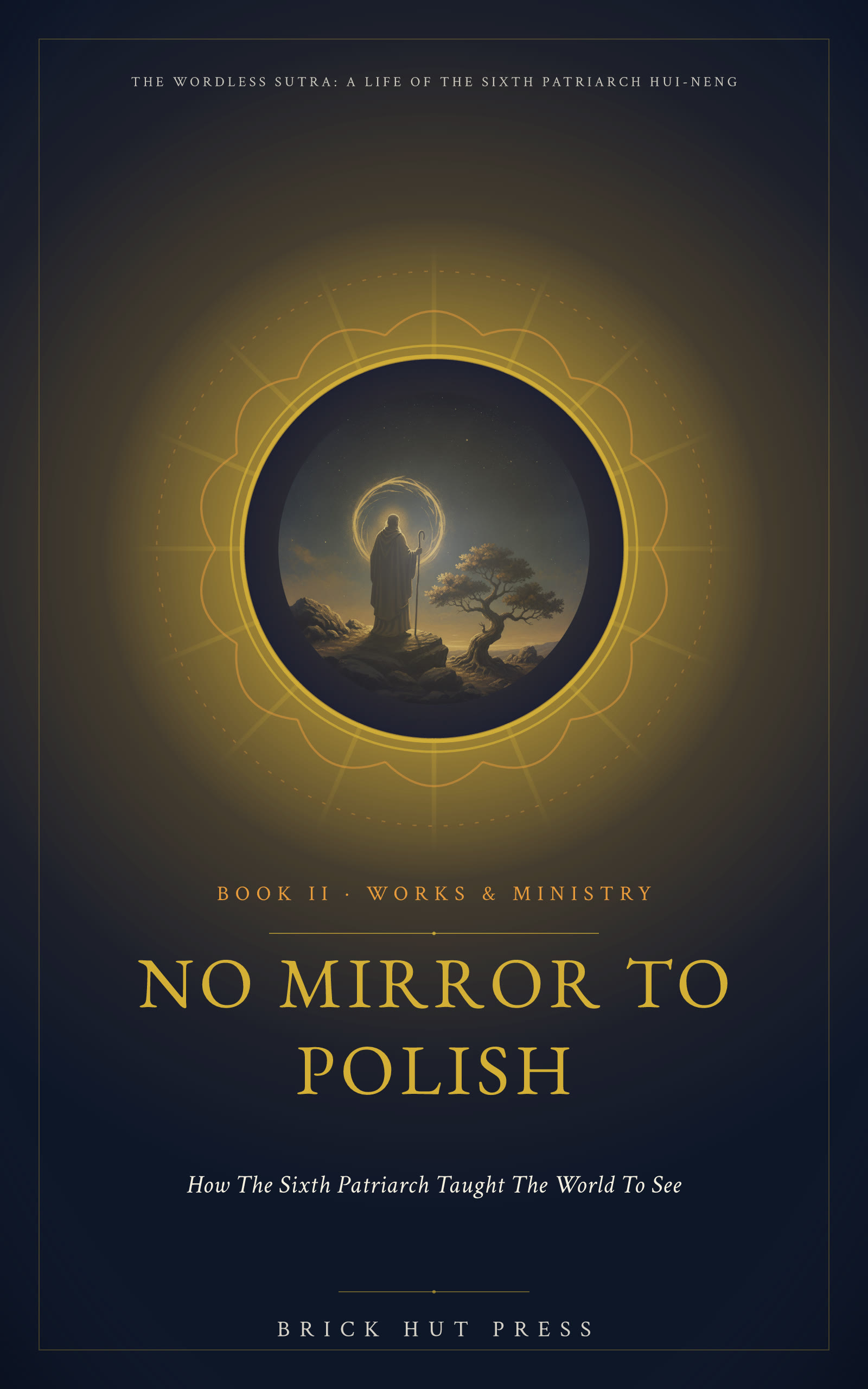
This is the third volume in The Wordless Sutra, and it is the one where the woodcutter who became the Sixth Patriarch stops being a story and becomes a voice speaking directly to the reader holding the book. Volume Three opens with Xue Jian's long ride up from Chang'an carrying the authority of the Tang throne itself, and the chapter that frames it, Buddha-Nature Has No North or South, sets the terms for everything that follows: the teaching Hui-neng gave an imperial envoy was identical to the teaching he gave a hunter mending nets in the mountains. No ceremony attached to it, no tiered access. That refusal to graduate the dharma by rank or learning is the spine of this volume, and it shows up again and again as the book turns to the sutra attributed to him, the Platform Sutra, asking in Chapter 2 and 3 what it means that this text has survived at all, and what kind of sutra it is that bears no single author's claim to it the way the sutras spoken by the Buddha do.
From there the volume settles into the four teachings that have carried Hui-neng's name through fifteen centuries of transmission: no-thought, no-form, and non-abiding. These are not treated as abstract doctrine. The chapters on No-Thought and No-Form take up, directly, why he would not let his followers freeze the teaching into an object of veneration, why a mind that touches everything and holds nothing is not a mind that has gone numb but one that has finally stopped flinching. Non-Abiding follows naturally: a chapter about the specific, practical freedom of a mind that refuses to settle into any fixed resting place, including the resting place of "Buddhist." Readers who have wondered why Chan teachers seem so allergic to pinning things down will find the reasoning laid out here plainly, in Hui-neng's own terms as the Platform Sutra records them.
The middle of the book turns to the famous hinge of his teaching, sudden awakening, and the volume does something useful here: it does not let "sudden" collapse into "easy." Chapter 7, The Door That Was Never Locked, and Chapter 8, The Diamond at the Root of Everything, trace how the line he heard from the Diamond Sutra, the line that is said to have broken him open as a young man selling firewood in the market, becomes the root of a whole teaching about awakening as removal rather than acquisition. Nothing is added to you at the moment of awakening. Something simply stops being in the way.
The closing third of the volume is where this book distinguishes itself from a straightforward life of a founder. Fifteen Centuries of Living Water and The Patriarch Comes West trace how Hui-neng's teaching moved, generation by generation, temple by temple, ocean by ocean, without losing the particular flavor of the man at Caoxi. The Body at Nanhua Temple takes up, directly and without embarrassment, the preserved body still seated at Nanhua, and treats it the way the tradition itself has always treated it: not as a curiosity but as a continuing presence. And the final two chapters, The Zendo in Your Own City and Your Original Face, bring the whole arc home to wherever the reader is sitting. This is a volume that trusts its reader to want not just the history of a six-century patriarch but the teaching itself, offered the way Hui-neng offered it to an emperor's envoy: plainly, without condescension, assuming the reader was never actually missing anything to begin with.
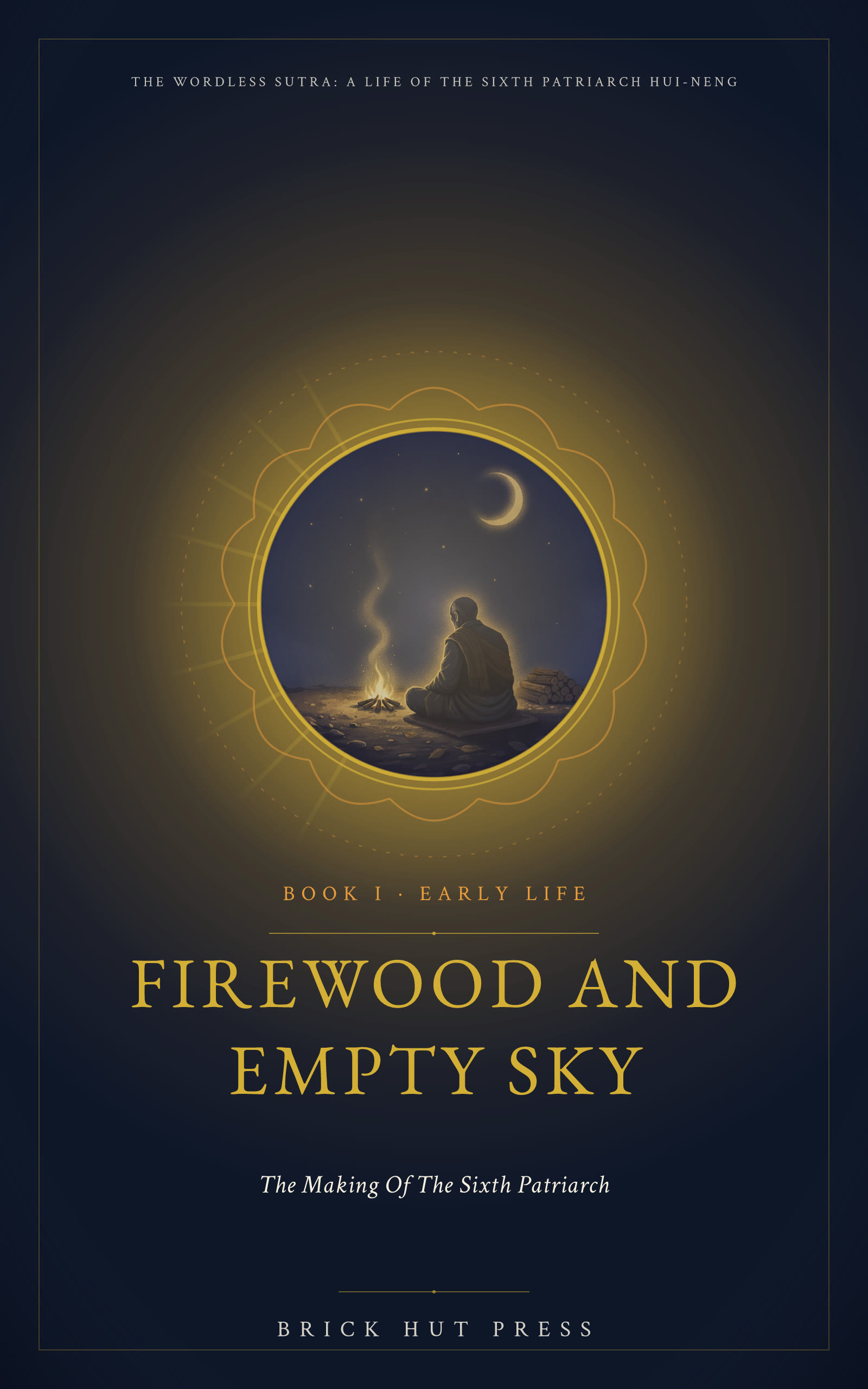
Lives that walk beside Hui-neng, chosen for their likeness, not their fame.