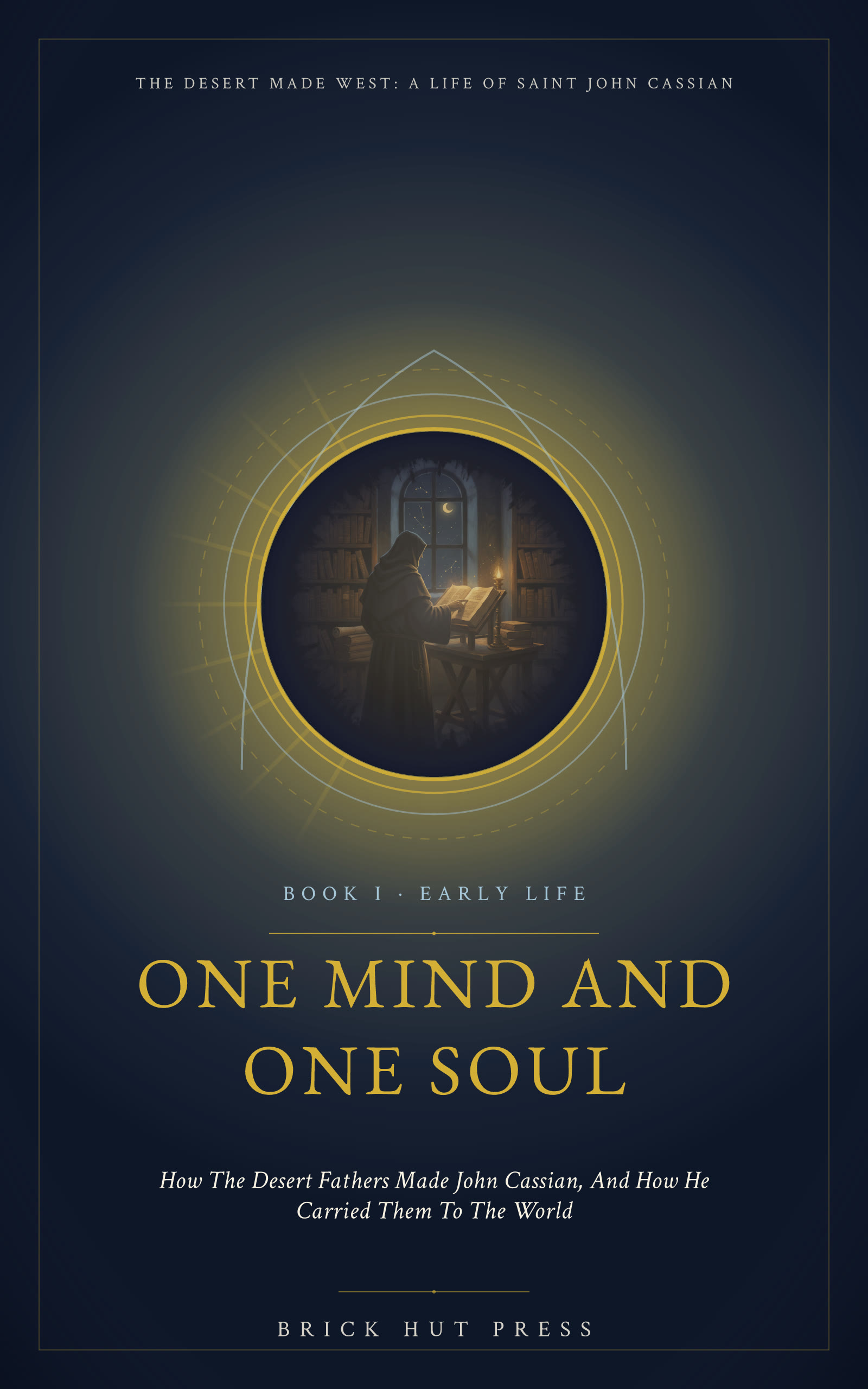
One Mind and One Soul
One Mind and One Soul tells the story of how the desert fathers made him, and how he, in turn, carried their wisdom to a world that desperately needed it.
He Left Everything to Find the Fire, and Brought It Back for the Rest of Us John Cassian walked into the Egyptian desert as a young man burning with holy hunger. What he found there, in the cells of the great Abbas, in the silence of the Nile delta, in the hard school of friendship and displacement, would shape not only his own soul but the entire contemplative tradition of the Christian West.
Read the full description
One Mind and One Soul tells the story of how the desert fathers made him, and how he, in turn, carried their wisdom to a world that desperately needed it. This is not a dry biography or an academic survey. It is a warm, unhurried devotional companion, the kind of book you read slowly, in the early morning, with a cup of something hot and a heart ready to be changed. It traces Cassian's formation through the deep bonds of friendship, the disorientation of exile, and the relentless mercy of a God who wastes nothing. And it asks, quietly but persistently, what the desert might still have to say to those of us who feel its tug today.
Not sure yet? Begin free.
The Man Who Carried Egypt West, a complete book about this life, free, kept in your own library here, read now; its narration joins free when it is finished.
Receive the free bookAbout this volume
This is the first volume of a life that will, in time, follow Saint John Cassian from the reedy delta of the lower Danube to the monastic schools of Gaul, but here the story stays close to the ground that made him: the riverbank of his boyhood, the roads to Bethlehem and Egypt, and the cells of the men who taught him how to pray. Readers who come to Cassian already knowing him as the bridge between the desert and the West, the figure who handed the wisdom of the Egyptian fathers to Latin-speaking monks who would never see the Nile, will find in this volume the years before that labor began: the long, patient formation that made such a transmission possible at all.
The book opens not with doctrine but with geography, tracing a boy born around the year 360 in Scythia Minor, a Roman province at the very lip of the empire, where the Danube breaks into marsh and reed before it reaches the sea. From there the chapters follow a young man of evident education and evident hunger, first to the household of a friend whose companionship made the pilgrimage to the East thinkable, then to Bethlehem, where he learned, as the chapter title has it, to kneel. The volume does not rush this. It treats the Bethlehem years as real formation, a necessary threshold before Egypt, rather than a mere stop on the way to somewhere more important.
The heart of the book is Egypt, and the volume is honest that Egypt did not meet expectations easily. A chapter called "The Desert Is Not What You Expected" sits near the center of the arc, and it earns its place: this is a book willing to show its reader a young monk's assumptions being dismantled before they are rebuilt on sturdier ground. From there the volume turns to the conversation with Abba Moses that would echo through the rest of Cassian's writing life, the "question that opened everything," and to the hard, unglamorous apprenticeship that followed: learning to fight the first skirmishes of the soul, sitting under a whole gallery of desert fathers each with his own counsel and his own silence, wrestling with the perennial monastic trouble of leaving a cell and returning to it with the same heart one left with.
Scete anchors much of the book's second half, treated here as what it was: a school at the edge of the world, where the discipline that would later shape Latin monasticism was first worked out in heat, hunger, and long attention. But the volume does not pretend this school was eternal. It follows the storm, doctrinal and political, that scattered the desert communities Cassian had come to depend on, and it closes with departure: Cassian leaving Egypt while Egypt does not leave him. The final chapter's title, "Leaving Egypt, Carrying Egypt," names precisely what this volume is building toward and what the next volume will have to reckon with.
What distinguishes this account is its refusal to treat Cassian's desert years as mere backstory to his later theological labors in the West. The book takes seriously that a man is formed before he teaches, that the Institutes and Conferences he would eventually write down for Gallic monks were not abstractions but memories, carried bodily out of cells and courtyards he had actually knelt in. Readers who want to understand why Cassian's later writing carries the particular weight and specificity it does, the sense that he is reporting rather than inventing, will find the sources of that authority laid out here in patient, grounded detail.
This is a volume for readers drawn to the desert fathers as living men rather than as proverbs, and for anyone who wants to watch, step by step, how a frontier-born boy from the edge of the Roman world became someone the whole of Western monasticism would eventually need.
Lives that walk beside Saint John Cassian, chosen for their likeness, not their fame.