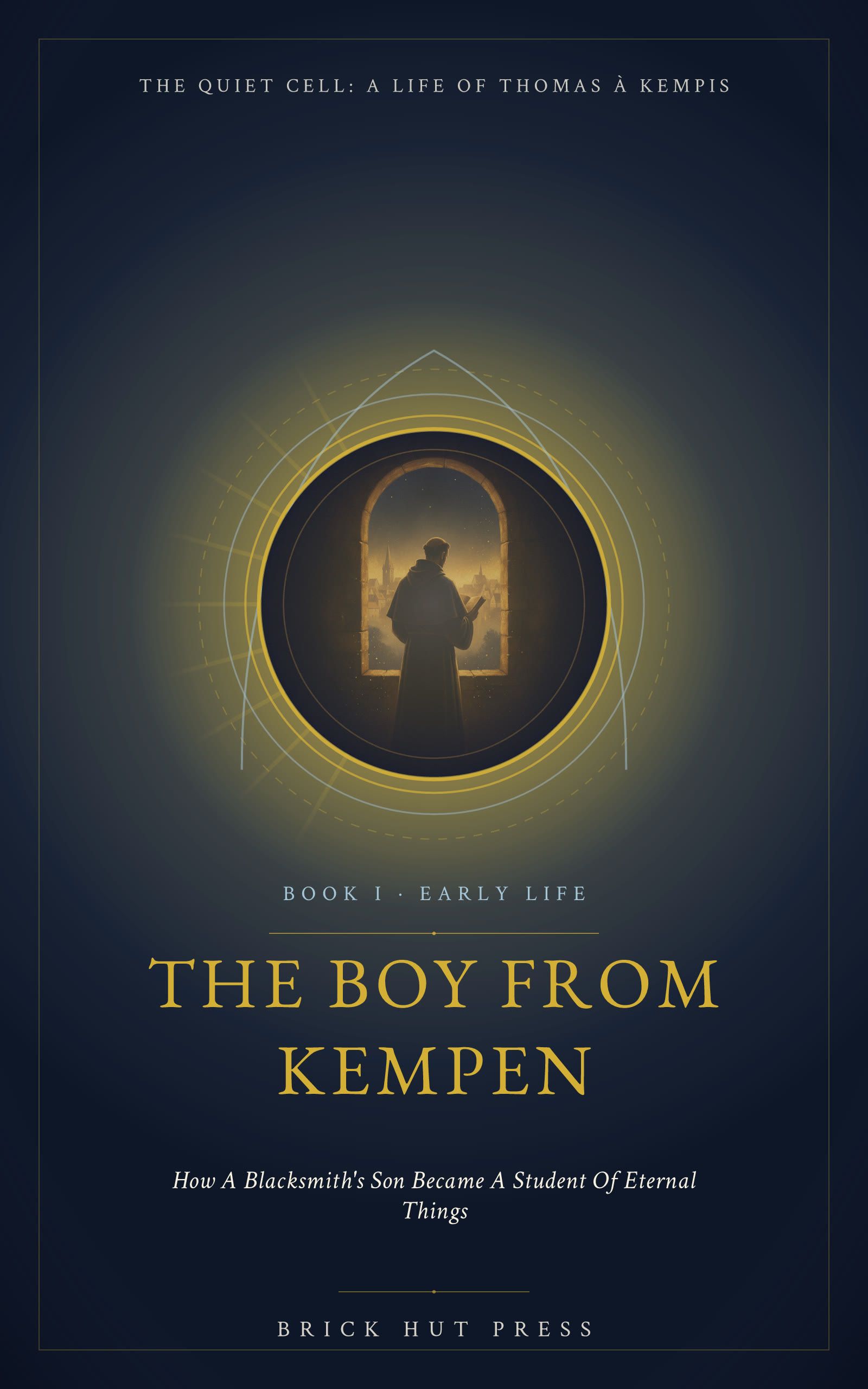
The Boy from Kempen
Yet Thomas à Kempis would grow up to write The Imitation of Christ , the most widely read Christian devotional in history after the Bible itself.
Before He Wrote the Words That Changed Millions of Lives, He Had to Learn How to Live Them He was born into the sound of hammer-strikes and vesper bells, a blacksmith's son in a small Rhineland town, an unlikely candidate for immortality. Yet Thomas à Kempis would grow up to write The Imitation of Christ , the most widely read Christian devotional in history after the Bible itself.
Read the full description
The Boy from Kempen tells the story that came before those famous pages: the life, the formation, the silence, and the slow burning of a soul set apart. This is not a dry biography. It is a reverent pilgrimage through the world that shaped Thomas, the forge and the family hearth, the transforming brotherhood of the Brethren of the Common Life, the cobblestone roads to Deventer, and finally the monastery cell where a vocation quietly took root. If you have ever been moved by the Imitation of Christ and wondered what made the man who wrote it , this book was written for you.
Not sure yet? Begin free.
The Lamp Still Burning, a complete book about this life, free, kept in your own library here, read now; its narration joins free when it is finished.
Receive the free bookAbout this volume
This first volume of The Quiet Cell begins not with vows or visions but with a forge, a bell, and a boy who has not yet learned to call what he is hearing by its name. Readers who come to Thomas à Kempis already knowing him as the author of The Imitation of Christ, the small book that has outlasted empires and outlived its own obscurity, may be surprised to find him here as Thomas Hemerken, a smith's son in the market town of Kempen, standing in a doorway between the sound of his father's hammer and the sound of the Propsteikirche's bell. That doubled sound, labor below and prayer above, becomes the volume's quiet organizing image: a boy learning, long before he has the words for it, to turn his head toward the eternal even while the ordinary world keeps working around him.
The book follows him from that doorway to the road itself. We watch his mother shape something in him that precedes doctrine, a disposition more than a teaching, before he ever leaves home. We walk with him to Deventer, into the orbit of Florentius Radewijns, the teacher who does not merely instruct the boy but shows him, patiently and practically, how to want God, which the volume treats as a harder and rarer lesson than any catechism. From there the chapters open onto the house on the IJssel and the school of the Common Life itself, that distinctive Devotio Moderna practice of living simply, working with one's hands, and holding books and prayers in common, a way of life that will mark everything Thomas writes in his later years at Agnietenberg.
Running beneath these chapters like a current is the presence of Geert Groote, the founder Thomas never met in the flesh but inherited as a kind of spiritual ancestor. The volume is careful and honest about this: it does not pretend an encounter that never happened, but it traces how a movement's founding spirit can pass to a second generation through institutions, through teachers, through the texture of daily practice, so that a man can be formed by a ghost as surely as by a living master. This is one of the volume's quieter achievements, showing how sanctity is often inherited sideways, through the slow accumulation of habits and examples rather than through any single dramatic transmission.
The middle chapters linger, rightly, over something easy to overlook: the physical labor of copying. Long before Thomas writes his own words, he copies the words of others, hour after hour, by hand, and the volume treats this discipline as formative rather than incidental, a schooling of patience and humility that will later surface in the plain, worn, repeatable cadences of his own prose. Prayers worn smooth by use, books copied by hand: these become the quiet machinery by which a soul is prepared for its own voice.
The volume closes with the long walk north to Agnietenberg and the slow, unglamorous passage from brother to novice, ending not with triumph but with vows: a cell, a pen, and a candle lit for the first time. It is a deliberately modest ending, refusing to rush ahead to the fame that will come later. Readers hoping for the Imitation itself, or for the mature spiritual master, will need to wait for later volumes in this series; what this one offers instead is the long, unrecorded apprenticeship that made such a book possible at all, the formation of an ordinary boy from an ordinary town into someone capable, decades later, of writing sentences that strangers in every century since have needed. It is a book about beginnings taken seriously, about the conviction that grace works on a soul long before that soul has any words for what is happening to it, and it asks its reader to be as patient with Thomas's slow formation as Thomas himself was taught to be.
Lives that walk beside Thomas à Kempis, chosen for their likeness, not their fame.