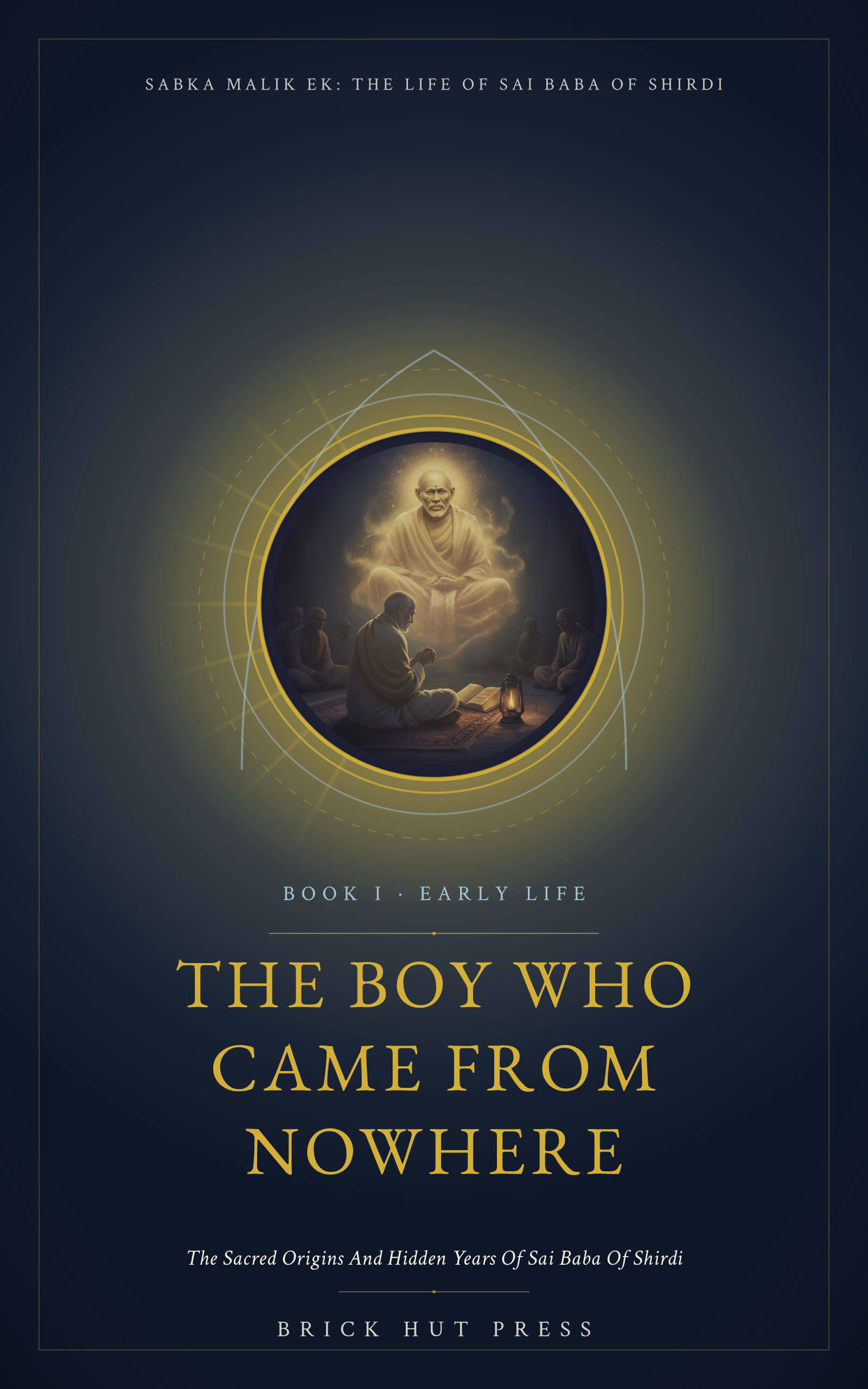
The Boy Who Came from Nowhere
No one knew where he came from.
He arrived at Shirdi as a boy of sixteen. No one knew where he came from. Millions would spend lifetimes trying to understand why he stayed. He sat beneath a neem tree on the edge of a dusty village, young and alone, wearing the robes of a fakir and carrying nothing but silence. The villagers were bewildered. The elders were uneasy. And yet something in his eyes stopped every question before it could leave the lips. Who are you? Where do you come from?
Read the full description
He never answered directly. He never needed to. The Boy Who Came from Nowhere is a devotional and deeply researched journey into the sacred mystery at the heart of Shirdi Sai Baba's life, the hidden years before Shirdi, the wandering, the forest, the Sufi master, and the unnamed forces that shaped one of the most beloved saints in human history. Drawing faithfully from the Shri Sai Satcharita and the living testimony of the tradition itself, this book does not speculate recklessly. It listens, carefully, reverently, to what the story has always been trying to tell us.
Not sure yet? Begin free.
The Fire That Never Went Out, a complete book about this life, free, kept in your own library here, read now; its narration joins free when it is finished.
Receive the free bookAbout this volume
This first volume of Sabka Malik Ek opens where every honest account of Shirdi Sai Baba must open: in uncertainty. There is no birth record, no named mother, no settled account of caste or creed, and this book does not pretend otherwise. Instead it does something more faithful to the tradition itself, which has always held that this saint arrived already complete, already turned toward God, asking nothing of history except that it make room for him. The Boy Who Came from Nowhere takes that absence seriously and builds around it a careful, reverent portrait of the years before Shirdi knew what it had received.
The volume moves chapter by chapter through the fragments that do survive: the possibility of a fakir father who left no name behind, the season spent under the Hindu guru at Selu, the wandering years with no fixed address and no fixed road. Readers who come expecting a conventional chronology will instead find something closer to how the Shirdi tradition itself has always told this story, through glimpses, through the testimony of villagers who remembered a strange quiet boy under a neem tree, through the slow accumulation of small wonders that only later revealed their size. The chapter on Chand Patil's wedding procession, where a young ascetic walks among drummers and singers without belonging to their celebration, is handled with particular care, since this is the hinge on which the whole book turns: the return that changed everything, the moment Shirdi stopped being a village he passed through and became the village that would hold him.
What distinguishes this volume is its refusal to resolve the ambiguity that devotees have lived with for over a century. Was the boy Hindu or Muslim by birth? The book does not force an answer, because Shirdi itself never forced one. A chapter is given fully to this tension, "The Mosque, the Temple, and the Man Between," and it treats that in-betweenness not as a puzzle to be solved but as the very ground of who this figure would become: a man who prayed facing the Dwarkamai's flame as naturally as he spoke the language of the Quran, who answered to a name, Sai, that belongs to no single tradition and was claimed by all of them. For a pan-Indian saint whose lineage resonances touch Sant Mat devotion and the Datta sampradaya alike, this refusal to pick a side is not evasion. It is the teaching.
The book also lingers, rightly, in the physical world that shaped him: the babul forest, the dry Deccan plain between two rivers, the dust and bullock carts and village bells slightly off their rhythm that any reader familiar with rural Maharashtra will recognize at once. This groundedness matters, because the chapters that follow, on the neem tree becoming an altar, on the fire within that the wilderness seemed to kindle in him, depend on a reader who can feel the heat and poverty of that landscape before being asked to see sanctity rising out of it. The prose does not rush toward miracle. It lets the ordinary evening, the smoke of cooking fires, the ragged wedding drums, carry the weight of what is about to be revealed.
By the time this volume closes, the reader has not been given a biography in the Western sense, with dates settled and parentage confirmed. What has been given instead is something Shirdi's own devotees would recognize as truer: an origin story shaped like a mystery deliberately left open, because the saint himself seemed to want it that way. This is a fitting first volume for anyone approaching Sai Baba of Shirdi for the first time, or returning to him after years of familiarity, since it restores the strangeness and wonder of those early, undocumented years before the fame, the udi, and the thousands of pilgrims. It asks the reader to sit, as the villagers once did, with a stranger under a tree, and to wait to see what stillness like that actually means.
Lives that walk beside Sai Baba of Shirdi, chosen for their likeness, not their fame.