The Nāga-Born
The Buddha Spoke His Name Before He Was Born.
The Buddha Spoke His Name Before He Was Born. What if the most important philosopher in Buddhist history was never meant to be a philosopher at all, but a bodhisattva, a serpent-king's guest, a keeper of scriptures the world was not yet ready to hold?
Read the full description
The Nāga-Born restores Nāgārjuna to his full, luminous strangeness, not as a footnote in Madhyamaka theory, but as a living presence walking the razor's edge between brilliance and destruction, between this world and the ones coiled beneath it. This is the story dharma students have been waiting for: the man behind the Mūlamadhyamakakārikā , told as sacred biography, as namthar, where philosophy is inseparable from fever dreams, initiation, and the mercy of great serpent-kings. If you have ever chanted Nāgārjuna's name in a lineage prayer and wondered who you were really invoking, this book answers that question with devotion, with drama, and with the full force of Mahāyāna imagination.
Not sure yet? Begin free.
Water From the Dragon's Realm, a complete book about this life, free, kept in your own library here, read now; its narration joins free when it is finished.
Receive the free bookAbout this volume
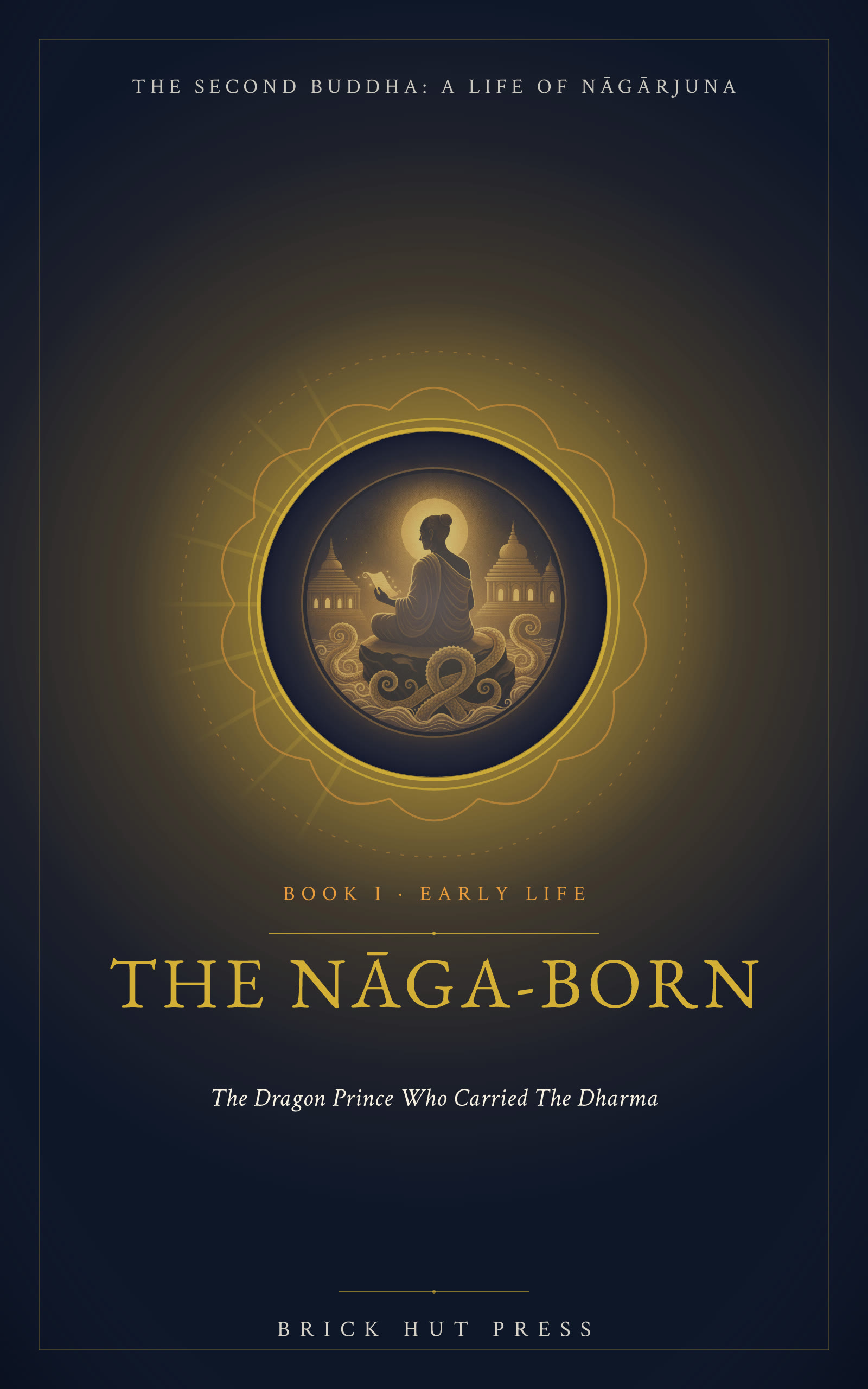
This first volume opens where tradition itself insists a life of Ācārya Nāgārjuna must open: not in a village in Andhra, but on a mountain called Malaya, in an assembly that includes bodhisattvas, nāgas, and the rākṣasa-king Rāvaṇa, where the Buddha, answering Mahāmati's long unspooling of questions, names a bhikṣu not yet born who will arise four hundred years after the parinirvāṇa in the country below the Vindhyas. The book takes this prophecy seriously as prophecy, the frame through which the Mahāyāna has always understood this figure, and only then descends to the red earth of Andhra, to the household and the childhood where an extraordinary mind first declared itself in ways that unsettled the adults around it.
The chapters that follow trace a boyhood almost too sharp for its own safety. "Too Brilliant to Be Safe" is not a flourish; it names an actual danger the volume takes up directly, the old accounts of a child whose intelligence outran the ordinary protections of family and caste, who had to be hidden from forces, worldly and otherworldly both, that could not tolerate what he was becoming. This leads toward a night that the volume treats as the hinge of the entire early life, a turning so complete that nothing after it resembles what came before. Readers who know the broader hagiography will recognize the shape of what is coming; readers who do not will find it laid out with the patience the material deserves, without rushing past the fear, the grief, or the clarity that made the turn possible.
From there the book follows him into robes he had not expected to want, a vocation arrived at sideways, through crisis rather than ambition, and then into monastic life itself: years of formation inside walls that, the title of chapter six tells us plainly, could not finally hold him. This is a volume about outgrowing structures without despising them, about a mind trained inside Buddhist monastic discipline reaching toward something the existing curriculum had not yet given language for. The rumors that begin to surface, of a hidden scripture, of teachings preserved somewhere outside the reach of the human teaching lineages, are presented here as rumors truly heard by a truly restless young monk, not as narrative ornament.
The volume's back half is a journey in the plainest sense: toward the great centers of learning where such rumors might be tested, and then toward an encounter the tradition has told for centuries and this book is not shy about telling again, the descent beneath the hood of the great serpent-king, into the undersea palace of the nāgas, where the Prajñāparamitā sutras are said to have been kept safe until a mind equal to them finally appeared to receive them. The volume closes not with those scriptures expounded, which belongs to later books in this life, but with the naming itself: how a Brahmin-born monk came to bear, permanently and inseparably, the name of the dragon who guarded what the world was not yet ready to read.
Those who come to this book wanting proofs or chronologies in the modern sense will find instead what the tradition has always offered and valued: a life told the way the lineage tells it, with the Lankavatara's prophecy and Tāranātha's history held as authoritative sources rather than curiosities, and with the nāga-world treated as real terrain in a real story. For practitioners and students of Madhyamaka who have long wondered what kind of person could first articulate emptiness with such rigor and such tenderness, this origin volume offers the only kind of answer that has ever satisfied the tradition itself: not analysis first, but the life, told in order, from the mountain where his coming was foretold to the hood beneath which his name was sealed.
Lives that walk beside Nāgārjuna, chosen for their likeness, not their fame.